Frozen Shoulder (Adhesive Capsulitis)
What is Frozen Shoulder?
Frozen shoulder, also known as adhesive capsulitis, is a condition characterized by pain and progressive stiffness of the shoulder joint. It occurs when the capsule surrounding the shoulder joint becomes inflamed, thickened, and contracted, restricting normal shoulder movement.
The exact cause of frozen shoulder is not completely understood. In many cases, it develops without any specific injury or identifiable event. It can also occur following a shoulder injury, surgery, or a period of prolonged immobilization.
Frozen shoulder most commonly affects individuals between the ages of 40 and 60. It is more common in women and is associated with certain medical conditions, particularly diabetes and thyroid disorders. It can affect either shoulder, and occasionally both shoulders over time.
Symptoms:
Frozen shoulder typically develops gradually, with increasing pain and stiffness over time. Common symptoms include:
Shoulder pain, particularly with movement and stretching.
Difficulty reaching overhead or behind the back.
Difficulty getting dressed, fastening a bra, or reaching into a back pocket.
Pain when sleeping, particularly when lying on the affected shoulder.
Progressive loss of shoulder motion, even when someone else attempts to move the arm.
One of the distinguishing features of frozen shoulder is that both active and passive shoulder motion become restricted. This means that the shoulder remains stiff even when someone else attempts to move the arm for you. External rotation (rotating the arm outward) is often particularly limited.
Stages of Frozen Shoulder:
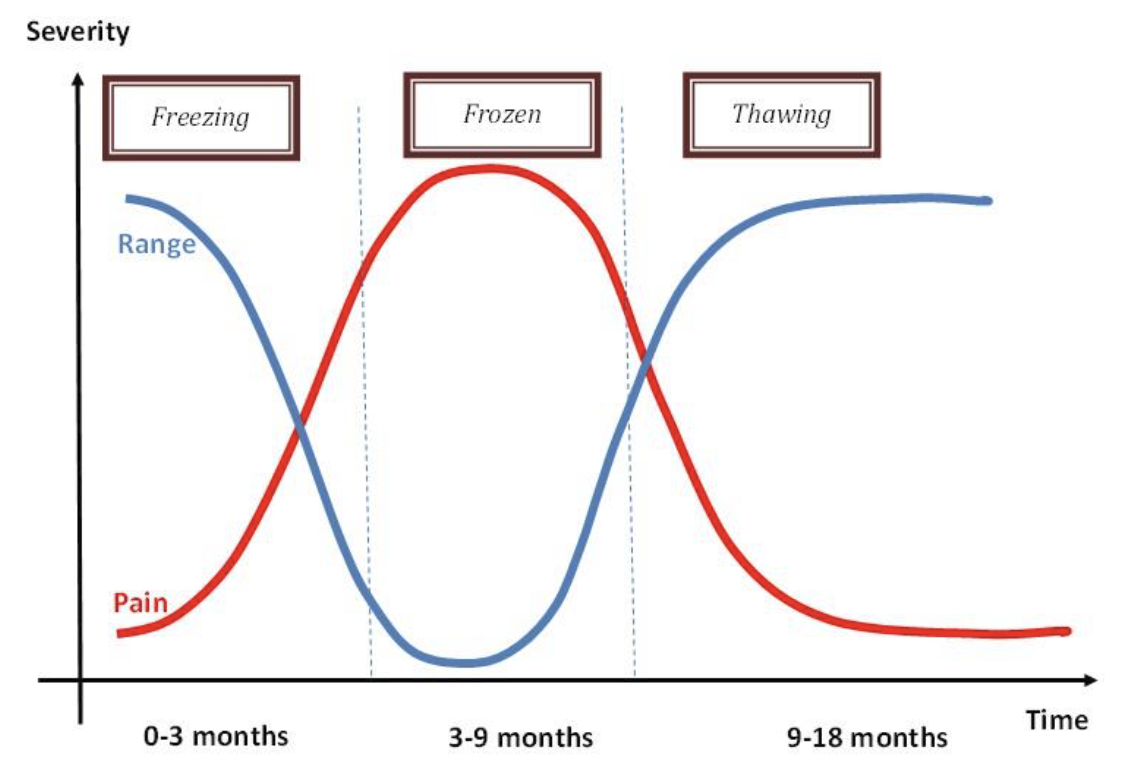
Frozen shoulder typically progresses through three overlapping stages:
1. Freezing Stage:
This initial stage is characterized by increasing shoulder pain and progressive loss of motion. Pain is often worse at night and can interfere with sleep. This stage can last several weeks to several months.
2. Frozen Stage:
During this stage, pain may gradually improve, but shoulder stiffness becomes more pronounced. Patients often have significant difficulty with overhead activities and reaching behind their back. This stage can last several months.
3. Thawing Stage:
During the final stage, shoulder motion gradually begins to return. Improvement is often slow and can take many months. Complete recovery can take one to three years or longer in some cases.
Not everyone experiences these stages in a predictable fashion, and some patients continue to have residual stiffness even after the condition has improved.
Diagnosis:
Frozen shoulder is typically diagnosed based on a patient's symptoms and physical examination. The most important finding is a restriction in both active and passive shoulder range of motion, particularly external rotation.
X-rays are often obtained to evaluate the shoulder joint and rule out other causes of stiffness, such as arthritis. An MRI is not routinely necessary to diagnose frozen shoulder but may be useful when there is concern for another underlying shoulder condition.
Treatment:
The vast majority of patients with frozen shoulder can be successfully treated without surgery. Treatment is focused on controlling pain and gradually restoring shoulder motion.
Medications and Anti-inflammatory Treatment:
Anti-inflammatory medications, such as ibuprofen or naproxen, may help reduce pain and inflammation when medically appropriate. Other pain medications may also be considered depending on individual circumstances.
Corticosteroid Injections:
A corticosteroid injection directly into the shoulder joint can help decrease inflammation and provide meaningful pain relief, particularly during the early stages of frozen shoulder. Reducing pain can make it easier to participate in physical therapy and perform stretching exercises.
Physical Therapy:
Physical therapy is an important component of treatment. A supervised stretching and home exercise program focuses on gradually restoring shoulder motion, particularly forward elevation and internal and external rotation.
Stretching should be performed consistently but should not be excessively aggressive. Forcing the shoulder through significant pain can aggravate inflammation and make symptoms worse. The appropriate intensity of stretching depends on the stage of the condition and the patient's symptoms.
Hydrodilatation:
In selected patients, an injection of fluid into the shoulder joint can be used to stretch the contracted joint capsule. This procedure, sometimes called hydrodilatation or joint distension, may be performed with corticosteroid and local anesthetic to help improve motion.
Surgical Treatment:
Surgery is rarely necessary for frozen shoulder. However, some patients continue to have significant pain and stiffness despite several months of appropriate nonsurgical treatment.
For patients with persistent symptoms, two surgical options may be considered:
Manipulation Under Anesthesia:
With the patient asleep under general anesthesia, the shoulder is carefully moved through its range of motion to stretch and release the contracted joint capsule and adhesions. This can help restore shoulder mobility without requiring surgical incisions.
Arthroscopic Capsular Release:
Arthroscopic capsular release is a minimally invasive procedure performed through small incisions around the shoulder. A camera and specialized instruments are used to release the thickened, contracted joint capsule, allowing the shoulder to move more freely.
In some cases, manipulation under anesthesia and arthroscopic capsular release are performed together.
Following either procedure, physical therapy is started immediately and is extremely important to maintain the motion gained during surgery and prevent recurrent stiffness.
Recovery and Prognosis:
Frozen shoulder can be a frustrating condition because recovery is often slow. However, most patients experience substantial improvement in pain and shoulder motion with appropriate treatment.
The condition can take many months, and sometimes several years, to resolve completely. Some patients experience residual stiffness, particularly those with diabetes or more severe cases of frozen shoulder.
Early evaluation and appropriate treatment can help control symptoms, improve function, and make the recovery process more manageable.
Shoulder:
Shoulder Fractures
Elbow:
Elbow Fractures
Cubital Tunnel Syndrome
Elbow Arthritis
Radial Head Fractures
Hand/Wrist:
Cubital Tunnel Syndrome
Hand Fractures
Scaphoid Fractures
Tendon Lacerations